TAM, SAM, SOM: Market Sizing Without the Confusion

 I’ll be honest with you — when I first encountered TAM, SAM, and SOM, I had no idea what these acronyms meant. And from my conversations with founders over the years, I know I’m not alone. In a conversation I had with a group of investors, they mentioned this issue as one of the common mistakes they encounter.
 
The thing is, people often feel embarrassed to ask. It seems like everyone else already knows, right? So founders nod along in meetings, pretending to understand, while secretly panicking inside.
Let me save you from that experience.

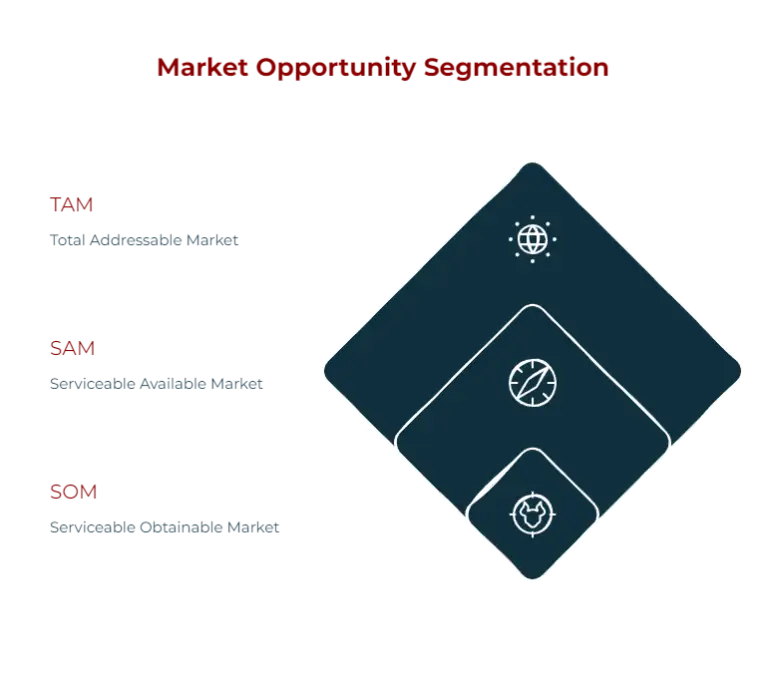
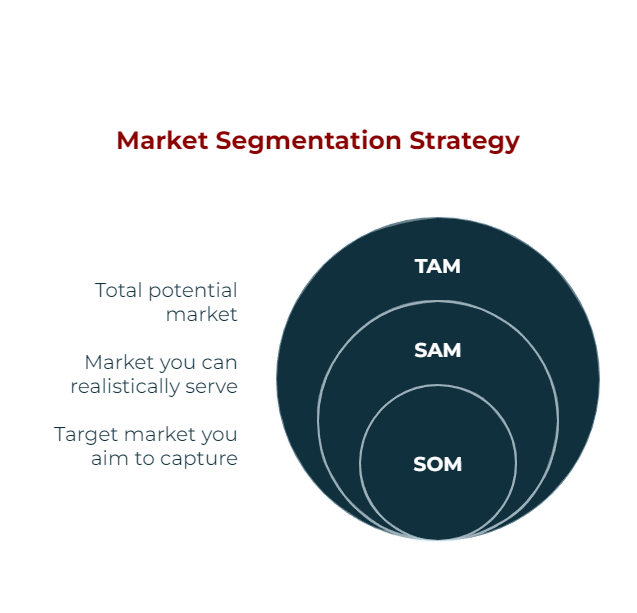
TAM (Total Addressable Market)

Definition: The total market demand for a product or service. It represents the maximum potential revenue if you captured 100% of the market.

Purpose: To demonstrate the overall size and potential of the market you’re operating in. It helps investors and stakeholders understand the broader context of your business.

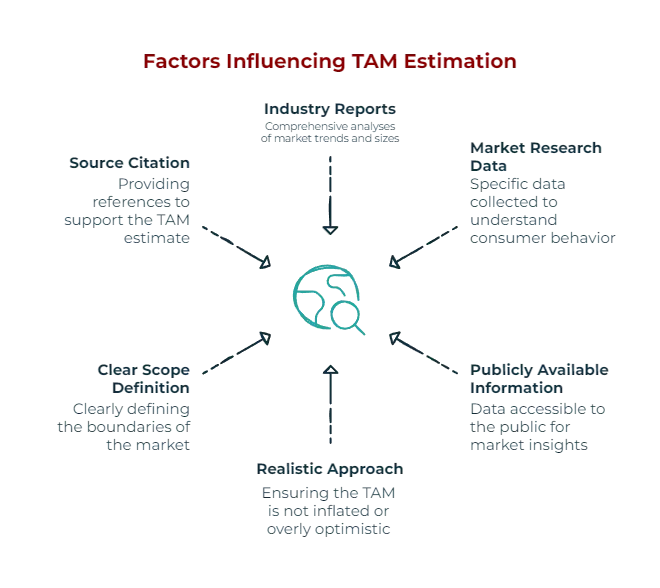
Calculation: Often involves top-down analysis, using industry reports, market research data, and publicly available information.

Example: For a new video conferencing platform, the TAM could be the total global spending on video conferencing solutions across all industries.

Considerations:

• Be realistic and avoid inflating the TAM.
• Clearly define the scope of the market you’re including.
• Cite your sources and data to support your TAM estimate.

SAM (Serviceable Available Market)


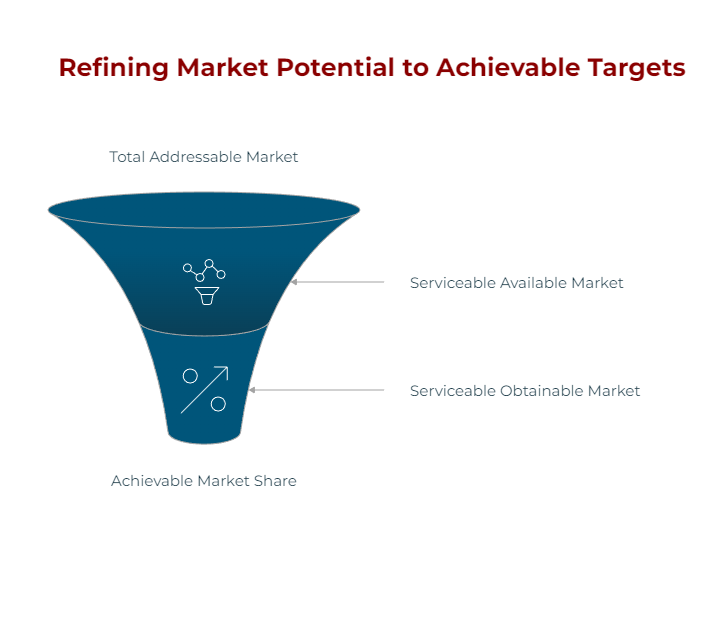
Definition: The segment of the TAM that you can realistically reach with your  current business model,  technology, and resources.

Purpose: To narrow down the TAM to a more relevant and  actionable market segment. It shows investors that you  understand your target audience and have a plan to  reach them.

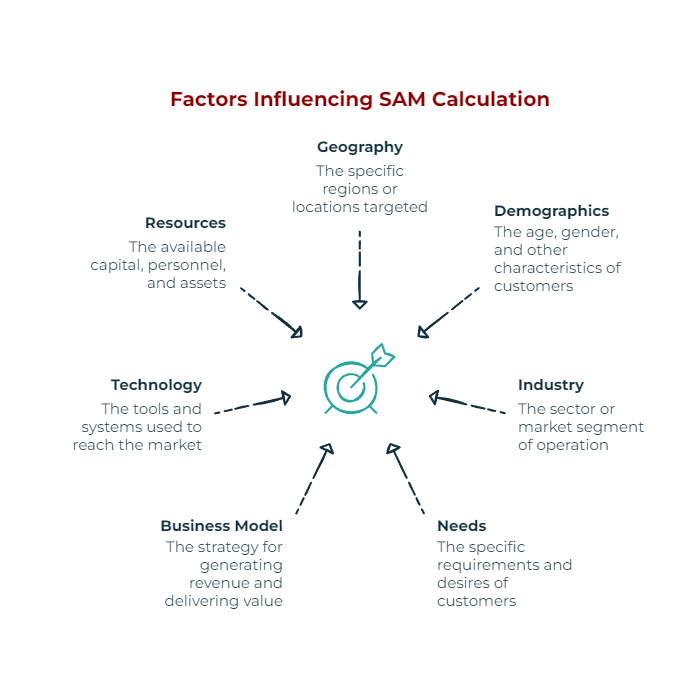
Calculation: Involves segmenting the TAM based on factors such as geography, customer demographics,  industry, and specific needs. 

Example: For the video conferencing platform, the SAM could be the spending on video conferencing solutions by small and medium-sized businesses (SMBs) in North America.

Considerations:

• Identify the specific characteristics of your target market.
• Consider factors such as geographic limitations, regulatory constraints, and technological barriers.
• Justify your segmentation criteria and explain why you’re focusing on this particular segment.

SOM (Serviceable Obtainable Market)


Definition: The portion of the SAM that you realistically expect to capture in the short to medium term, given your current resources, competitive landscape, and marketing efforts.

Purpose: To provide a realistic and achievable target for your business. It demonstrates to investors that you have a clear understanding of your market position and a plan to gain market share.

Calculation: Involves considering factors such as your sales capacity, marketing budget, competitive intensity, and customer acquisition cost.

Example: For the video conferencing platform, the SOM could be capturing 5% of the SMB video conferencing market in North America within the next three years.

Considerations:
• Be conservative and avoid overestimating your SOM.
• Consider your competitive advantages and how you will differentiate yourself from competitors.
• Develop a clear go-to-market strategy and outline the steps you will take to achieve your SOM.

Still confused? You're not alone. Let me explain with an example.


The Green Can Example

Imagine you’ve invented a revolutionary eco-friendly beverage can. It’s completely biodegradable — drop it in water and it dissolves harmlessly. No more landfills overflowing with aluminum cans.
Now, when someone asks about your market size, you might be tempted to say: “The global beverage market is worth trillions of dollars!”
And technically, you’re not wrong. But that number is meaningless for your business.
 

TAM: The Total Addressable Market

Your TAM is the total market demand for your specific product or service. You’re not selling to the entire beverage industry — you’re selling eco-friendly cans. Not bottles. Not cartons. Not kegs. Just cans.
So your TAM might be the global can market, which is significantly smaller than “all beverages.”
 

SAM: The Serviceable Available Market

Here’s where we get more realistic. Not everyone who buys cans cares about sustainability. Some companies and consumers simply won’t pay a premium for an eco-friendly option — it’s just not a priority for them.
So your SAM is the portion of the can market that you could actually serve. Maybe that’s the segment of environmentally conscious companies and consumers. If you estimate that 30% of the market prioritizes sustainability (and I’m being optimistic here), that’s your SAM.
 

SOM: The Serviceable Obtainable Market

Now we get practical. Even within your SAM, you can’t capture 100% of those customers right away. You’re a new company. You have limited resources. You’re probably starting in one or two countries, maybe partnering with one major beverage brand initially.
Your SOM is what you can realistically capture in your first few years. Maybe you’re targeting the European market first, or focusing exclusively on a partnership with one sustainable beverage company. That’s your obtainable slice.
 

The Importance of Clear Reasoning

The key to effectively using the TAM, SAM, and SOM framework is to provide clear and
logical reasoning for how you moved from one level to the next. Your pitch should clearly
articulate:

• How you defined your TAM: What market are you including, and why? What data supports your estimate?
• How you segmented your SAM: What criteria did you use to narrow down the TAM? Why
is this segment a good fit for your product or service?
• How you calculated your SOM: What factors did you consider when estimating your achievable market share? What is your go-to-market strategy?

By providing a clear and well-reasoned explanation of your TAM, SAM, and SOM, you can demonstrate to investors that you have a deep understanding of your market opportunity and a realistic plan for success.

Why Investors Care About This


Here’s what I’ve seen go wrong in pitch meetings: founders throw out massive TAM numbers hoping to impress investors.

“We’re entering a $50 billion market!”
 
Investors aren’t impressed. They’re skeptical.
 
What investors actually want to see is that you understand the realistic opportunity. They want to know:
 

You’re not confusing the broader industry with your specific market

You’ve identified who will actually buy your product

You have a focused, achievable plan for market entry

When you can clearly articulate your TAM, SAM, and SOM — and explain the logic behind each number — you demonstrate that you actually understand your market. That builds confidence.

The Startup Playbook: Create a Killer Investor Pitch and Business Plan

Want to learn exactly how to calculate your TAM, SAM, and SOM — with templates and real examples? The Startup Playbook includes a full chapter on market analysis, plus an Excel template to help you build these projections. Grab your copy AMAZON and stop guessing at your market size.


Skip to content